Latest release: v0.35.0-beta1
A changed hotkey or restored nuclear mechanic can affect your next match immediately. These openfront patch notes explain the October 13, 2026 beta, including new ranked queues, account progression, smarter Nations, and changes returning players should check before playing.
As of October 14, the newest entry on the official GitHub releases page is tagged v0.35.0-beta1. Its release description uses the heading v0.35.0, but the published tag identifies a beta. These changes should therefore be read as beta release notes, without assuming every public client already includes them.
The OpenFront Intel changelog separately summarizes earlier releases through v34, highlighting v34.22. Its version pages help trace older balance changes, while the developer's release entry gives the details for the newer beta.
Ranked queues and player progression
The beta adds ranked Free For All and Clan Wars alongside the game's earlier ranked development. Both introduce different competitive structures, so individual FFA results and clan ratings should be understood separately.
| Queue | Players and matchmaking | Match structure |
|---|---|---|
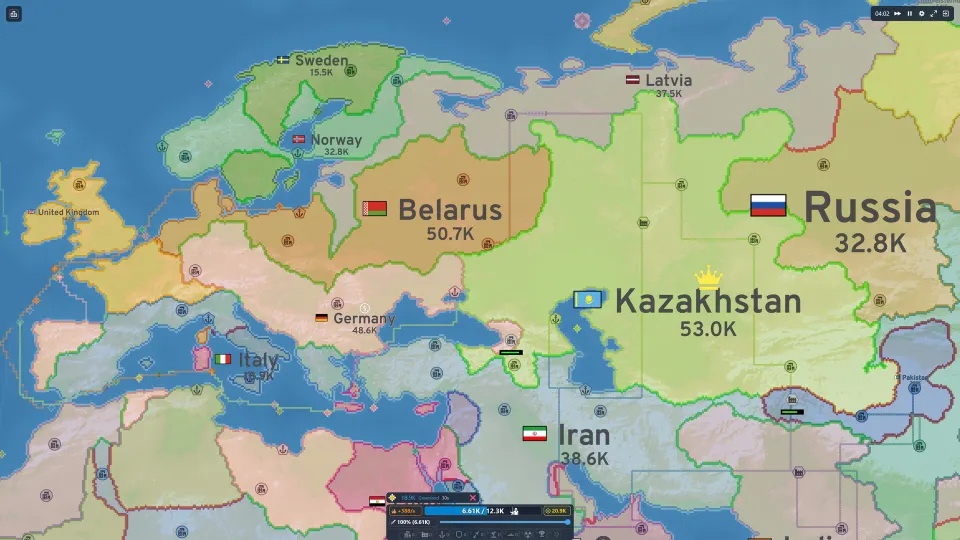
| Ranked Free For All | 4–10 players matched by Elo | Continent maps, a 20-minute timer, and an ending condition of one remaining human |
| Ranked Clan Wars | 2–5 players per side, with up to four clans | Team competition that raises or lowers the participating clan's rating |
Ranked access now requires a trusted account. Lock icons appear on the Ranked button and its modal to indicate restricted access. The clan leaderboard also gains a sortable Elo column, making competitive clan standings easier to compare.
Clan browsing changes too. The default listing uses a randomized order for each player, replacing the advantage of alphabetically early names. Additional sorting options and paid featured placement through clan boosts are also listed.
Player progression adds XP earnings after games. The results screen breaks those earnings down by source and displays level increases. Eliminated players receive an initial XP estimate immediately; that figure is reconciled with the server's result when the match finishes.
Level badges appear in lobbies, player panels, ranked leaderboards, and clan lists. At level 100, players can Prestige, progressing through P10 and then Legend. Profiles gain a progression tab, a reward track awarding Plutonium every 25 levels, and share links. Account Settings allow players to hide their level and exclude their profile from search engines.
Combat, Nations, and match integrity
Nuclear attacks regain an annexation behavior that had stopped working in many coastal situations. When a blast separates a section of territory from its main landmass, the surrounding enemy can receive that isolated section again.
For players, the practical implication is that a nuclear strike can change ownership beyond its immediate blast area. Narrow connections between larger territories deserve attention because severing one may isolate land. This is a tactical implication of the restored mechanic, rather than a separate damage increase.
Nation AI receives a broad update, while Easy Nations retain their previous behavior. The changes affect several recognizable situations:
- Border preparation: Nations continue building and place defensive positions behind the front before attacking.
- Amphibious attacks: Hard and Impossible Nations can send boats with 1% of their troops, then launch a land attack immediately after the landing.
- Landing defense: Nations respond at beachheads and avoid placing defense posts directly on top of one another.
- Nuclear targeting: Nations avoid wasting blasts on water or fallout, coordinate to avoid duplicate targets, and retaliate with nukes.
- FFA leaders: Nations can concentrate pressure on an opponent pulling far ahead.
- Naval movement: Boats route around warships, and warship groups can challenge blockades.
Medium difficulty and above also avoid saving for nukes before reaching three cities. Together, these changes make economic development, border preparation, and retaliation more prominent in Nation behavior.
Several fixes address match integrity. An unreachable-target exploit could generate free troop refunds; that loophole is closed. Invalid troop counts now cause an attack to be rejected instead of removing the player from the game.
Disputed winner votes and outcomes decided by a single voter receive server replay checks. The release also fixes a vulnerability that allowed forged end-of-game statistics.
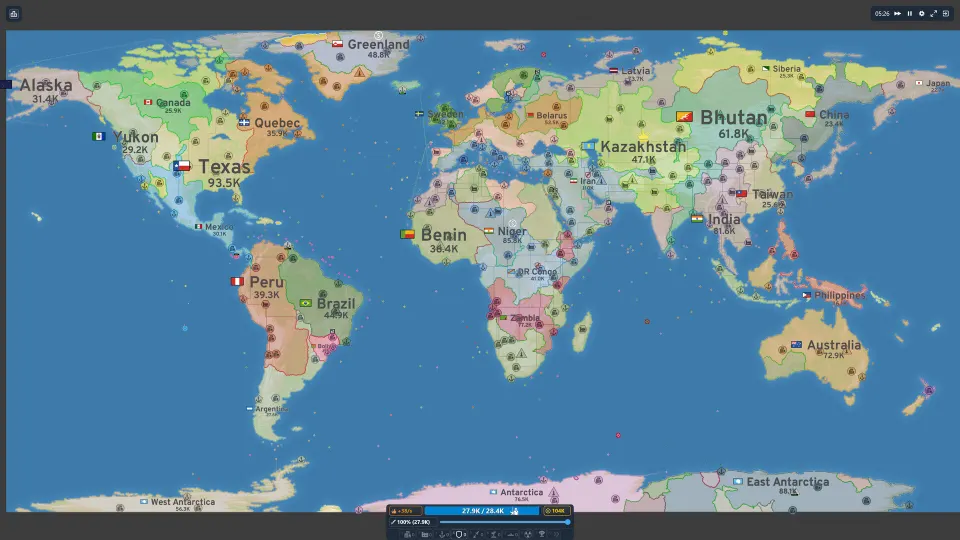
Controls, maps, and replay improvements
The beta changes familiar communication shortcuts. Returning players should check these bindings before relying on muscle memory, especially when selecting warships.
| Input | Behavior described in the beta notes |
|---|---|
| R | Opens quick chat for the player under the cursor |
| F | Opens the redesigned emoji menu |
| X | Selects all of your warships, replacing F |
| Q, W, E, A, S, D | Activates favorite emojis within the emoji interface |
The emoji menu groups its options and supports a Favorites row populated by dragging emojis into place. Human players can send up to five emojis to each recipient within five seconds, compared with the previous limit of one.
The official site's help table lists F for selecting all warships, while the beta notes assign that action to X. This difference makes checking the running version important when following shortcut instructions.
Public lobby capacity also changes. The fixed 125-player ceiling is removed, and capacity instead comes from the map's land area.
| Map | Capacity listed in the beta notes |
|---|---|
| The Box | 210 players |
| Alps | 185 players |
| Middle East | 170 players |
Alps and The Box also appear more frequently. These figures are map-specific examples, rather than a single new capacity applied to every lobby.
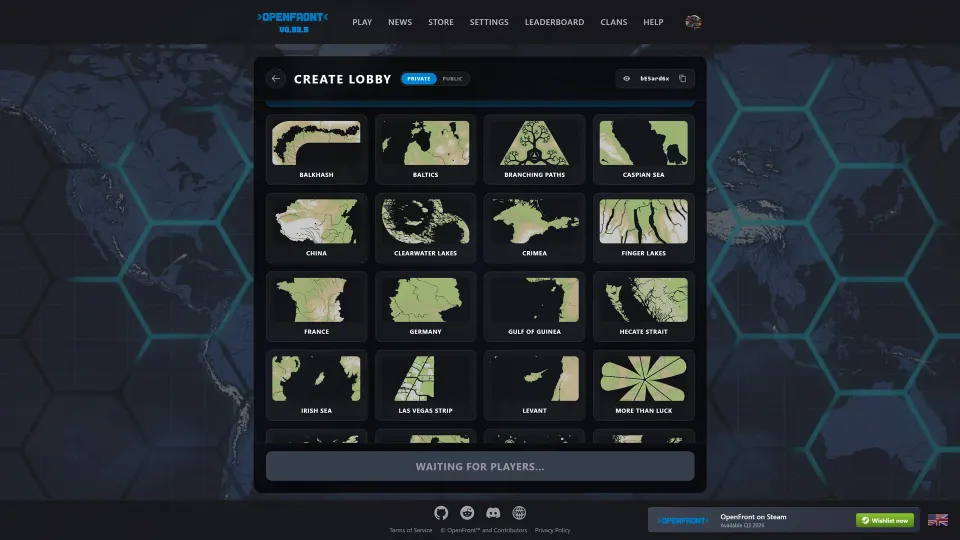
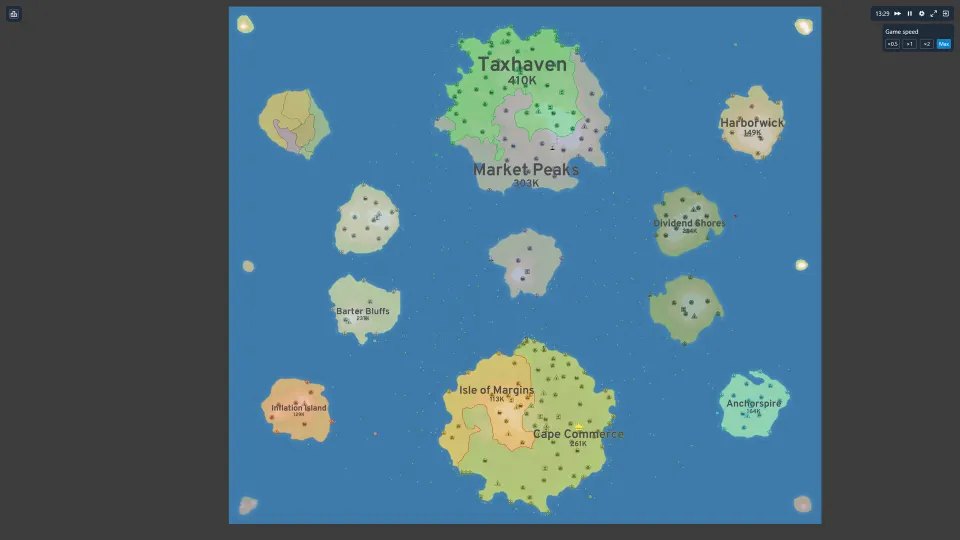
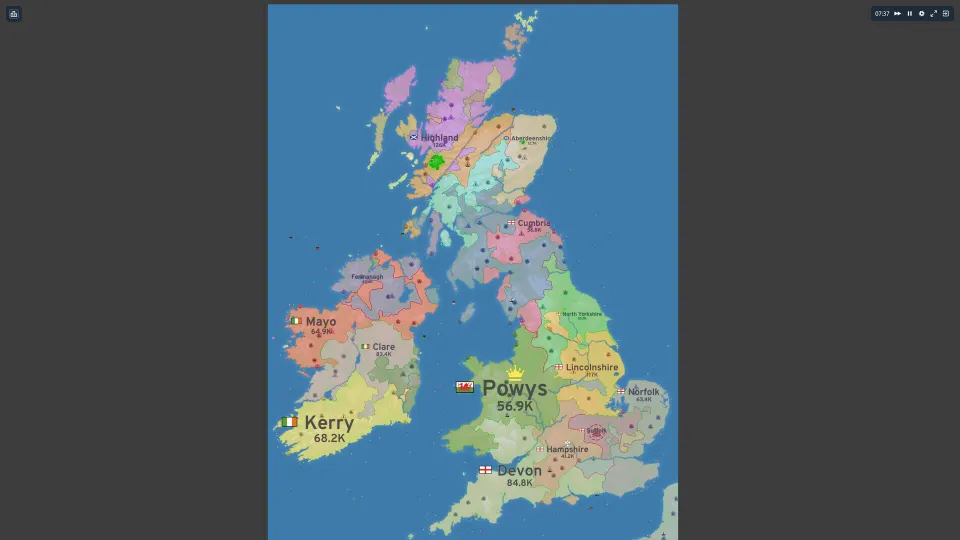
Eight maps are listed: Madagascar, Horn of Africa, Vancouver Island, Cape of Good Hope, Canary Islands, Bab el-Mandeb Strait, Rio de Janeiro, and Pulicat Lake. Madagascar is described as a Nuke Wars map in the style of Baikal.
Finished matches can open from game history in a replay viewer with timeline seeking. The browser processes the match once, after which jumps to other points are described as taking approximately 20 milliseconds. This supports reviewing a decisive landing or nuclear exchange without watching the entire match again.
The homepage also becomes lighter. Its initial compressed download falls from 661 KB to 220 KB, with the game client, store, and individual modals loaded as needed.
Earlier updates and balance changes
Older patch notes explain why familiar strategies may behave differently after a long break. The following dates are the release-series dates listed by OpenFront Intel; summaries may include later patches within that series.
| Version series | Listed date | Notable changes |
|---|---|---|
| v34 | September 22, 2026 | The index highlights v34.22 changes involving combat, team victory, trade, trains, Steam, and lobbies |
| v33 | July 31, 2026 | v33.14 restores modal scrolling and makes Overtime the default for public FFA |
| v32 | June 17, 2026 | WebGL, expanded trade networks, faster nukes, and the Doomsday Clock |
| v31 | May 3, 2026 | Clan management, Water Nukes, and ports and ships operating on inland water |
| v30 | March 12, 2026 | Separate FFA, Teams, and Special public queues; global trade-ship cap increases from 100 to 400 |
| v29 | January 19, 2026 | Ranked 1v1, a menu rework, improved naval pathfinding, and single-player achievements |
| v28 | December 18, 2025 | MIRV cost escalation of 15 million per global launch, a Retaliate button, and SAM interception previews |
| v27 | November 22, 2025 | Greater range from stacked SAMs, troop losses when transports retreat, and reduced naval banking |
| v26 | October 14, 2025 | Reworked building and player interfaces, resource gifting, rails crossing rivers, and team takeover of AFK territory |
| v25 | August 21, 2025 | Fixed base income of 1,000 gold per second, removal of worker/troop allocation, and public-lobby factories and trains |
| v24 | July 18, 2025 | Trains, factories, and building upgrades |
For returning players, v25 is an especially useful checkpoint. Advice built around the removed worker/troop allocation bar describes an older economic system. Later changes to trade capacity and MIRV pricing further affect how players fund expansion and late-game attacks.
Version scope also matters. A page labeled v33 may discuss improvements introduced in v33.14, while a v34 overview can include v34.22. Check the specific patch mentioned before assigning every change to the series' opening release.
FAQ
Where can I find official openfront patch notes?
The developer's GitHub releases page lists release tags and detailed changes. OpenFront Intel provides community-written summaries organized by version. Use the exact release tag when distinguishing a beta from a numbered release-series overview.
Is v0.35.0 a confirmed stable release?
The October 13 entry is tagged v0.35.0-beta1, despite using v0.35.0 as a heading inside its description. A stable v0.35.0 release has not been officially confirmed by that beta entry.
Why does the Steam announcement use v0.1.10?
The official Steam announcement dated September 19, 2026 is titled “Patch Notes for v0.1.10.” A direct equivalence between that label and GitHub's v0.34 or v0.35 numbering has not been officially confirmed. Keep the platform and exact version label attached when comparing announcements.
Which changes should returning players check first?
Check your client's controls, then review economic and combat changes since your last session. The beta's F-to-X warship shortcut change, restored nuclear annexation, and updated Nation behavior directly affect match decisions. Players returning from before v25 should also review the removal of worker/troop allocation.