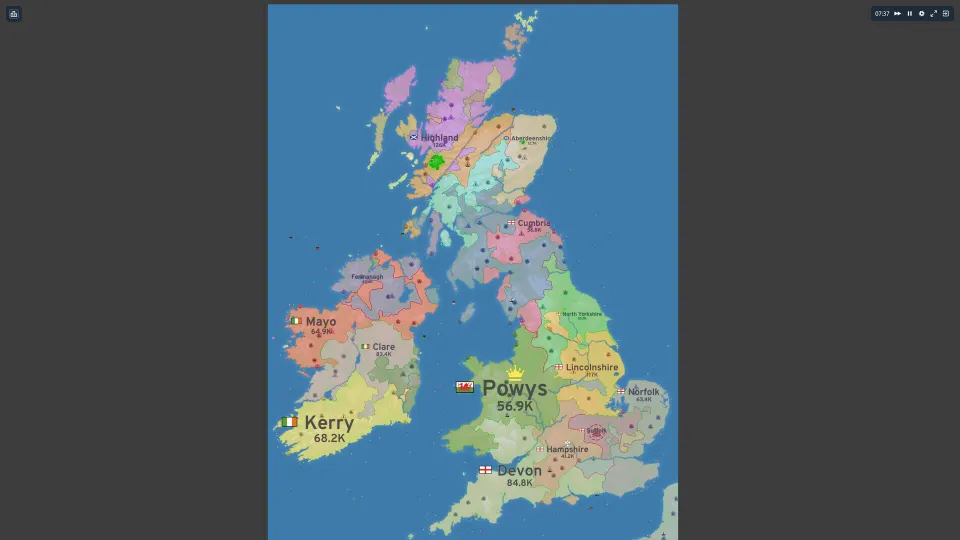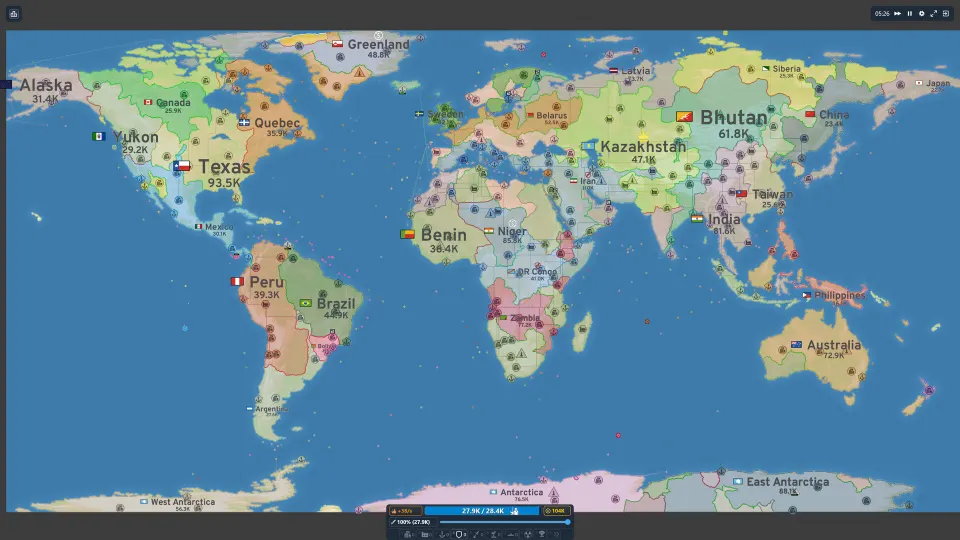
Balance growth with survival
Economy matters because a larger territory is not automatically a stronger position. Spending troops for land can improve your future capacity, but an unsafe border or an awkward shape can turn that investment into an immediate collapse.
The central decision is not whether to expand forever. It is whether the next capture leaves enough troops, improves your position, and avoids creating more danger than it removes.
Troop growth is shaped by both your current troops and your maximum troop capacity:
| Economy factor | Source-backed rule |
|---|---|
| Population cap base | 2 × (tiles^0.6 × 1000 + 50,000) + Σ(cityLevel × 250,000) |
| Human multiplier | ×1 |
| Bot multiplier | ÷3 |
| Nation difficulty multipliers | Easy ×0.5, Medium ×0.75, Hard ×1, Impossible ×1.25 |
| Troop growth rate | (10 + troops^0.73 / 4) × (1 - troops / maxTroops) |
The final factor reduces growth as troops approach maximum capacity. At the same time, the troops^0.73 term means growth is not strongest at zero troops. For common human caps, the highest raw troop generation is close to 42% of the cap.
Treat that number as a planning signal, not an order. A player with exposed borders may need a larger reserve than the mathematical growth peak suggests.
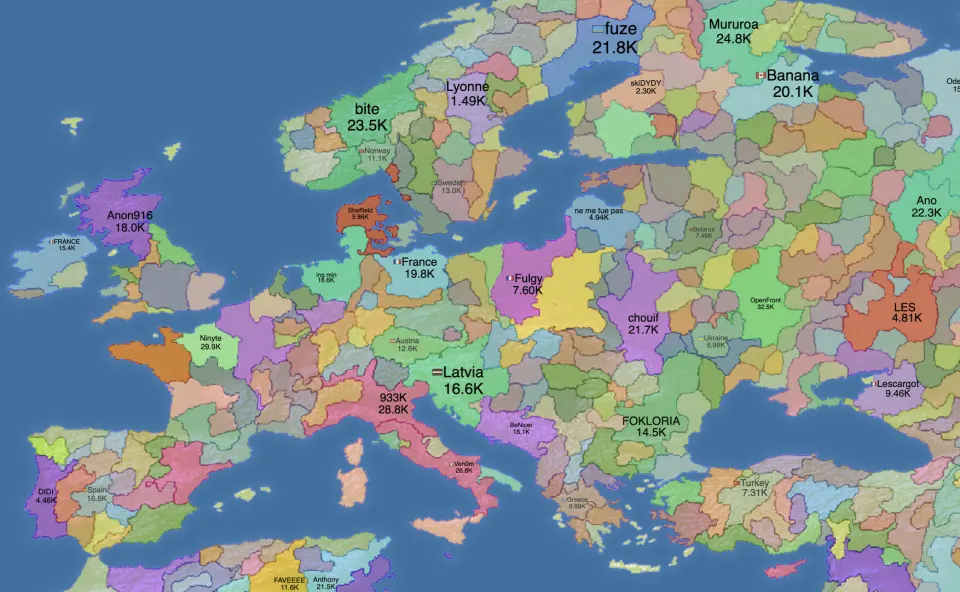
Use troop bands to choose your next move
Your troop percentage is a quick way to evaluate whether land, recovery, or defense should come next. The useful target is a range that changes with the map rather than one permanent number.
| Current troops | What the formula indicates | Practical use |
|---|---|---|
| Below 30% | Growth has headroom, but deterrence is low | Pause optional wars; take only cheap neutral land or a capture that immediately removes danger |
| 35–50% | Near peak raw troop growth | Use quiet periods for efficient expansion and short, decisive attacks |
| 50–70% | Slower growth with a stronger reserve | Prefer this range at contested chokepoints, before betrayal, or when two rivals can reach you |
| 70–80% | Growth is visibly throttled | Hold this much for a known timing, credible threat, or expensive follow-up |
| Above 80% | The cap factor is 0.20 or less | If safe, use troops for useful land or raise capacity instead of waiting at a nearly full bar |
A quiet frontier can support expansion around the 35–50% range. If the nearest opponent is separated by neutral land and each capture keeps one coherent border, low-cost tiles can be worthwhile.
That changes when an attack opens a route to another opponent, creates a thin corridor, or turns one border into two. A larger country can become poorer in practical terms when it must defend more exposed edges.
On a contested chokepoint, holding 55–65% can be preferable to dropping back toward 42%. The raw-growth peak does not protect against a rival that can attack immediately. Preserve the reserve when the border itself is the main risk.
Check the position before expanding
Before committing troops, judge the result after the capture rather than the number shown before you click. Four checks help separate useful expansion from an expensive war budget.
- Is the land cheap? A short neutral edge or weak disconnected pocket may pay for itself. A long push into defended land is a larger commitment.
- What remains after the capture? Falling below roughly 30% with an enemy nearby is a warning to rebuild.
- Does the shape improve? A compact choke, coast connection, or closed pocket can justify slower recovery.
- Is capacity really the bottleneck? More capacity helps when troops are near 80% and the position is safe. It does not solve repeated troop losses in fights.
| Situation | Recommended priority | Reason |
|---|---|---|
| Quiet outer frontier near 45% of cap | Continue low-cost captures | The ratio remains near the growth band and the border stays coherent |
| Route opens another opponent | Stop or reassess | The new border can create more pressure than the land provides |
| Rival contests a narrow border | Preserve 55–65% reserve | Immediate defensive strength can matter more than peak raw growth |
| Safe position above 80% of cap | Use troops or raise capacity | Growth is heavily throttled near a full bar |
| Troops are low after repeated fighting | Address the losses first | Another City does not repair the underlying problem |
A Defense Post can be useful when it resolves a contested choke. Its value comes from reducing pressure at the important border, not from following a fixed timetable.
The same principle applies after a war. Stop optional captures if rebuilding offers more safety than the next tile. Expansion is strongest when it improves both capacity and the shape of the position.
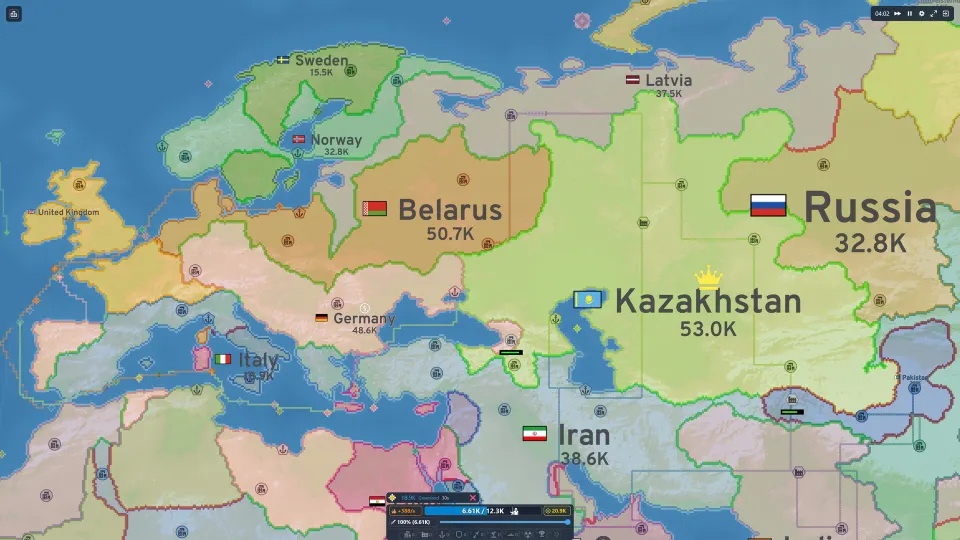
Understand cities and capacity
Cities directly contribute to population cap through the city-level term in the cap formula. Each city level adds 250,000 inside the summed city contribution. That makes city levels relevant when capacity, rather than troop losses or border danger, limits what you can do.
| Capacity input | Formula contribution |
|---|---|
| Tiles | 2 × (tiles^0.6 × 1000 + 50,000) base structure |
| City level | 250,000 per city level in the summed contribution |
| Human population type | ×1 multiplier |
| Bot population type | ÷3 multiplier |
| Nation difficulty | Easy ×0.5; Medium ×0.75; Hard ×1; Impossible ×1.25 |
Do not treat a City as an automatic answer to every economy problem. If you are close to 80% of capacity, safe, and unable to make productive use of additional troops because the bar is nearly full, more cap can help.
If you are low on troops because attacks keep failing, additional cap does not replace safer decisions. The immediate question is whether you are losing troops to a poor border, a defended push, or a position that creates too many active fronts.
This is why city decisions and expansion decisions belong together. Territory affects the base cap, city levels contribute to cap, and troop percentage determines how quickly forces regenerate. But none of those numbers remove the need to protect the map shape.
A compact core with manageable borders can be more useful than a larger territory connected by a vulnerable corridor. When a capture closes a pocket or creates a better choke, slower recovery may be acceptable. When it merely adds distance and opponents, recovery usually deserves priority.
FAQ
What is the main lesson of this openfront economy guide?
Keep troop growth, capacity, and border safety in balance. The fastest raw growth is commonly near 42% of cap, but safer reserves are often better when opponents can attack.
When should I stop taking land?
Stop optional expansion when the next capture creates another active border, pushes you below roughly 30% of cap near an enemy, or provides less safety than rebuilding troops.
Is 42% of troop cap always the best target?
No. It is near the raw troop-growth peak for common human caps, not a universal tactical target. Contested borders can justify holding 50–70% instead.
When does more capacity help most?
More capacity is most relevant when troops are near 80% of cap and the position is safe. If troop losses come from fighting or exposed borders, solve that problem before treating capacity as the answer.