Why Giant World Map Matters
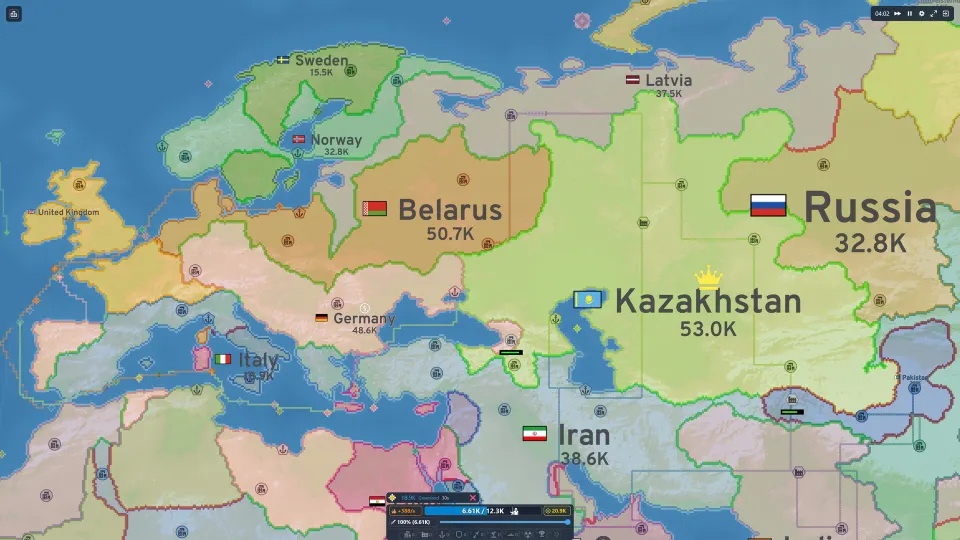
If you are looking for the OpenFront biggest map, Giant World Map is the map to check first. It is described as a larger version of World, creating more room for expansion, logistics, water routes, and delayed contact between players.
Giant World Map matters because its scale changes the early priorities of a match. OpenFront.fyi groups it with maps best suited to long-form matches, where players can plan several fronts, experience delayed contact, and build a larger trade network before conflict becomes central.
The map is not simply a larger land battlefield. Much of it is water, so access to waterways and control of naval movement can strongly shape a game. The Panama Canal is present, while the Suez Canal does not exist on Giant World Map.
| Map detail | Details |
|---|---|
| Map name | Giant World Map |
| Relationship to World | It is much like World, except bigger |
| Broad category | Continental map |
| Match style | Listed as best for long-form matches |
| Named nations | 107 |
For a player, the practical takeaway is simple: this is a map where distance and water deserve attention from the opening. A position that looks isolated on land may still connect to major routes by sea.
Terrain and World Layout
Giant World Map depicts a giant version of the world. Its terrain includes flat, hilly, and mountainous areas spread fairly evenly across the map, although the distribution varies by continent.
Asia tends to have more mountainous terrain. Africa tends to be hillier. South America tends to be flatter. Those broad patterns can help players decide where movement may be more constrained and where expansion may be more open.
| Area | Terrain tendency |
|---|---|
| Asia | More mountainous |
| Africa | More hilly |
| South America | More flat |
| Overall map | Flat, hilly, and mountainous terrain are fairly evenly spread |
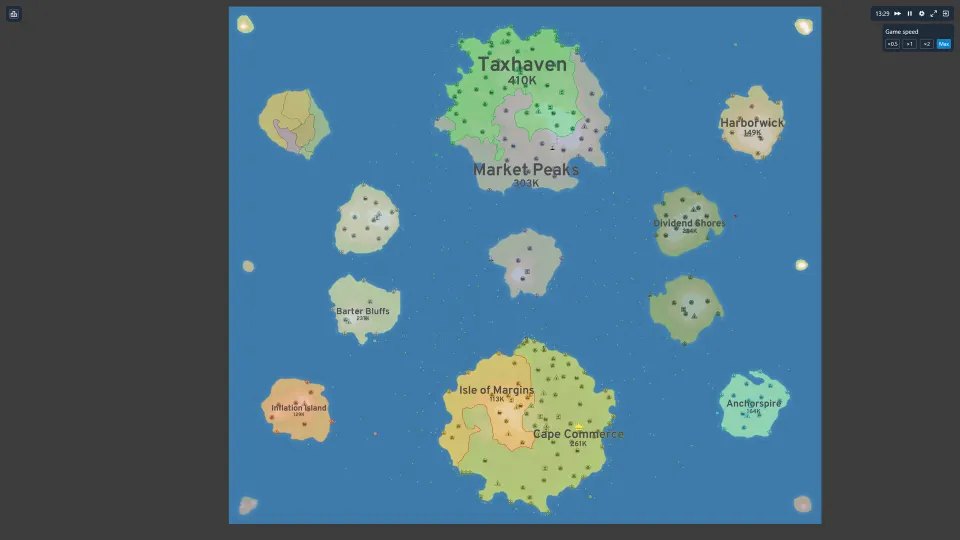
The map is mostly water. That makes its geography different from a continent-focused map where land borders alone determine the opening. Players should trace connected water rather than assuming a familiar Earth-shaped coastline will behave like a purely land-based arena.
OpenFront.fyi recommends a three-pass map check for large maps:
- Estimate contact distance from the map’s scale and playable land.
- Trace connected seas, straits, and islands to understand water routes.
- Check symmetry and lobby size before comparing openings.
That advice is especially relevant here. Giant World Map offers a recognizable global setting, but the meaningful strategic question is how routes connect in the current match, not just which real-world region a player recognizes.
Water Routes, Trade, and Warships
Water is one of Giant World Map’s defining features. Both the OpenFront Wiki and Miraheze description identify the map as one of the best maps for trade and warships because so much of the map is water.
The Panama Canal is a key point in the map’s layout. It can connect routes that would otherwise require a much longer trip around the Americas. The Miraheze source specifically notes that the Suez Canal does not exist on Giant World Map, so players should not expect the same shortcut between the Mediterranean region and the Red Sea that may be associated with World.
| Route or feature | Giant World Map status | Strategic relevance |
|---|---|---|
| Water coverage | Most of the map is water | Supports trade and warship use |
| Panama Canal | Present | Connects important water routes |
| Suez Canal | Does not exist | Cannot be used as a shortcut |
| Trade ships | Especially useful | The map is among the best for trade |
| Warships | Especially useful | The map is among the best for warships |
A useful opening habit is to identify whether your territory can reach connected water early. On this map, ports and naval routes may be central rather than optional. The exact value of a route still depends on the current lobby and player positions, so inspect the lobby preview before committing to a plan.
Players who prefer a wider, more logistical game may find the map appealing because it can support long-distance planning. Players who prefer immediate land contact should also account for the possibility that early expansion takes longer before opponents become reachable.
How It Compares With World and Other Long Maps
Giant World Map should not be confused with World or Known World. The OpenFront Wiki explicitly distinguishes it from both. Its closest comparison is World: it is much like World, but bigger.
The distinction matters because a larger version of a familiar layout can alter timing. OpenFront.fyi says larger maps reward economy and logistics before contact. It also places Giant World Map alongside Africa, Asia, Australia, Europe, Europe Classic, North America, Oceania, South America, and World as maps suited to long-form matches.
| Map group from OpenFront.fyi | Included examples |
|---|---|
| Best for long-form matches | Africa, Asia, Australia, Europe |
| Best for long-form matches | Europe Classic, Giant World Map, North America |
| Best for long-form matches | Oceania, South America, World |
| Geographic but different category | Luna, Mars, Milky Way, Pangaea, Pluto, Sol, Surrounded, Titan |
| Abstract layouts | Branching Paths, Chopping Block, Labyrinth, Onion, Sierpinski, The Box |
The map’s larger scale does not automatically make every choice better. A player still needs to evaluate playable land, nearby water, route connectivity, and the lobby setup. The source guidance cautions against relying on Earth-like expectations: inspect water connectivity and playable corridors before choosing a build.
For repeatable strategy testing, abstract and tournament-oriented maps may offer more symmetry. Giant World Map instead emphasizes a broad world layout, regional terrain differences, and extensive water. Its appeal is the scope of the map and the range of potential routes.
Planning a Giant World Map Match
Start by reading the geography around your spawn. Identify the amount of nearby land, whether water is connected to larger seas, and whether a canal can affect your route. Since the map has a great deal of water, isolated-looking land positions may have meaningful naval access.
Then think about when contact is likely to happen. OpenFront.fyi’s guidance for larger maps is to use scale and playable land to estimate whether the economy can mature before first contact. On Giant World Map, that question is often more useful than assuming an immediate fight.
A concise planning checklist can keep the opening focused:
- Check the lobby preview rather than relying only on the map name.
- Find connected water and possible naval routes.
- Note whether the Panama Canal changes access between areas.
- Do not plan around a Suez Canal route on this map.
- Consider terrain tendencies when choosing a direction of expansion.
- Expect larger maps to place more weight on economy and logistics before contact.
The terrain description offers a starting point, not a complete route guide. Asia’s more mountainous character, Africa’s hillier terrain, and South America’s flatter terrain are broad map-level observations. Your actual decisions should depend on nearby corridors, coastlines, and the positions visible in the lobby.
Giant World Map is therefore best understood as a large, water-heavy World-style map. It rewards players who can combine territorial expansion with awareness of naval movement and trade opportunities.
FAQ
Is Giant World Map the OpenFront biggest map?
Giant World Map is described by the OpenFront Wiki as being like World, except bigger. It is a large, long-form map, but its total size relative to every OpenFront map has not been officially confirmed.
Does Giant World Map have the Panama Canal?
Yes. The Panama Canal is present and contributes to the map’s strong trade and warship potential.
Does Giant World Map have the Suez Canal?
No. The Miraheze source states that the Suez Canal does not exist on Giant World Map.
How many named nations does Giant World Map feature?
The OpenFront Wiki states that Giant World Map features 107 named nations.
What is Giant World Map best for?
It is one of the best maps for trade ships and warships. OpenFront.fyi also lists it among the maps best suited to long-form matches, with larger trade networks and delayed contact.