Why Warships Matter
Warships turn water routes into a contested part of an OpenFront match. They can attack hostile warships and transport ships, capture eligible trade ships, and help deny opponents the economic value moving across the sea.
A fleet is especially useful where ports, trade routes, and open water create frequent contact with enemy vessels. Their value is not just direct combat: a captured trade ship switches to the warship owner's nation and can generate more gold.
Warships are a building subtype called a boat in one source, while another describes them as naval units. In practical terms, they are purchased for water operations and depend on ports for key support.
| Capability | What warships do |
|---|---|
| Naval combat | Attack nearby enemy warships and transport ships |
| Trade capture | Capture qualifying trade ships and assign them to the warship owner's nation |
| Patrol | Remain in an assigned area when no targets are present |
| Chase | Pursue eligible trade ships |
| Water movement | Move freely in water rather than being territory-bound |
The general game economy makes ports especially important. Ports generate trade ships, grow the economy, and allow players to build warships for attacking and raiding. That means naval strength begins with shoreline access and a functioning port network.
Buying and Deploying a Warship
To buy a warship, target a water source, open the build menu, and purchase it with enough gold. The warship appears at the nearest owned port and moves toward the targeted location.
A port is therefore a basic requirement before deployment. Build one on a shoreline first, then select water where you want the ship to operate. This creates a clear setup sequence:
- Establish a port on a shoreline.
- Choose a water location from the build menu.
- Purchase the warship with sufficient gold.
- Let it deploy from the nearest owned port toward the selected area.
The first warship costs 250,000 gold. Each additional owned warship increases the price by 250,000 gold, up to a maximum cost of 1,000,000 gold.
| Warships owned after purchase | Purchase cost |
|---|---|
| 1 | 250,000 gold |
| 2 | 500,000 gold |
| 3 | 750,000 gold |
| 4 or more | 1,000,000 gold maximum |
The documented formula is:
cost = Math.min(1_000_000, (numWarships + 1) * 250_000)
Because each additional ship becomes more expensive, a larger fleet should have a clear purpose. A player may want coverage for active trade routes, protection against enemy transports, or pressure on an opponent's water access. Buying ships without an area to patrol or targets to contest can tie up gold that could otherwise support cities, ports, factories, defenses, or missile infrastructure.
Movement, Patrols, and Port Support
A warship can normally move one tile per tick, with each tick listed as 100 milliseconds. It is not territory-bound and can move freely in water. When chasing trade ships, it doubles its speed to two tiles per tick.
Warships patrol their assigned area when no targets are present. If hostile vessels enter their targeting range, they engage automatically. After targets are eliminated, the ships return to patrol.
| Property | Documented value or behavior |
|---|---|
| Health | 1,000 HP |
| Normal movement | 1 tile per tick |
| Chase movement | 2 tiles per tick |
| Territory restriction | None in water |
| Repair rate | 1 HP per tick with at least one port |
| Targeting range | 130 tiles |
Ports remain essential after a ship is deployed. Warships heal one HP per tick when their owner has at least one port. A source also states that warships do not heal or capture trade when their owning player has no port.
This makes the loss of every port a serious naval setback. A ship may still be present on the water, but it loses repair support and cannot capture trade ships. Protecting shoreline infrastructure is therefore part of protecting the fleet.
One source describes direct selection and movement by clicking a warship and then clicking water. Another says warships cannot be manually controlled. Since these sources conflict, players should treat patrol assignment and the current in-game controls as the authority for their version rather than relying on either description alone.
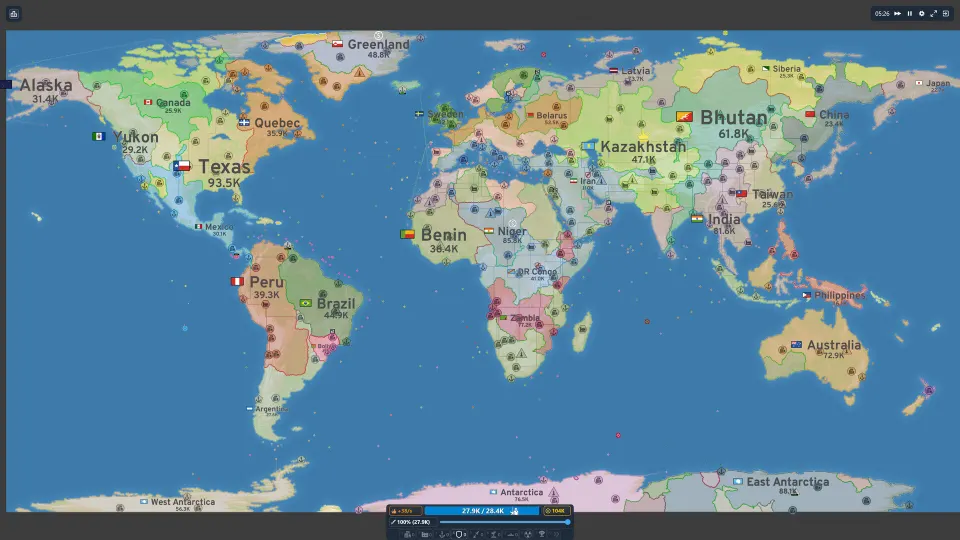
Combat and Trade-Ship Capture
Warships automatically fight enemy warships and transport ships. During combat, they fire shells until the target is destroyed. Their documented combat rate is one shell every 20 ticks, or two seconds, and each shell deals 250 damage.
| Combat detail | Documented value |
|---|---|
| Attack rate | One shell every 20 ticks |
| Attack interval | 2 seconds |
| Damage per shell | 250 |
| Shell lifetime | 20 ticks / 2 seconds |
| Shell speed | 3 tiles per tick |
| Targeting range | 130 tiles |
When several possible targets are present, warships use a stated priority order:
- Transport ships
- Enemy warships
- Trade ships
A warship instantly reloads after shooting a transport ship, according to the source. That makes transport ships a particularly important threat and opportunity when naval units meet.
Trade capture is different from destroying a target. When a warship encounters a trade ship that is not heading to one of the warship owner's ports, it rushes toward the ship and captures it upon contact. The captured trade ship is assigned to the warship owner's nation.
Not every trade ship can be captured. The ship must meet all relevant conditions:
- It cannot belong to you or one of your allies.
- It cannot be heading toward one of your ports.
- It cannot belong to a player allied with your ally.
- It cannot be near a coast.
The game can help identify these cases when the player holds the space bar. Trade ships appear green when they belong to the player or are headed to one of that player's ports. Yellow indicates that an alliance makes the ship uncapturable. Red identifies a capturable trade ship.
This color system matters because capture rules include ownership, destination, alliance relationships, and coastal position. Before committing a warship to a chase, confirm that the target is actually eligible.
FAQ
What are openfront warships used for?
Openfront warships patrol water, attack enemy warships and transport ships, and capture eligible trade ships. Captured trade ships switch to the warship owner's nation and can generate more gold.
How much does a warship cost?
The first costs 250,000 gold. The cost rises by 250,000 gold for each ship owned, with a maximum purchase cost of 1,000,000 gold.
Do warships need ports?
Yes. A warship spawns from the nearest owned port after purchase. Having at least one port also enables its documented repair rate, and a source states that ships cannot heal or capture trade without a port.
What ships do warships target first?
Their listed priority is transport ships first, then enemy warships, then trade ships.
Can every enemy trade ship be captured?
No. A trade ship is not capturable if it belongs to you or an ally, is traveling to your port, belongs to a player allied with your ally, or is near a coast.